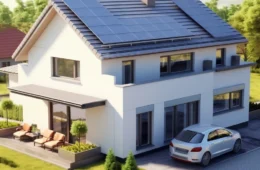
Flat roofs are everywhere in Ireland: kitchen extensions, garages, dormers, apartment blocks, offices and warehouses. The good news is that solar panels on a flat roof in Ireland are entirely workable. The panels are tilted up on frames, which lets the installer choose the direction and angle rather than being stuck with the roof’s pitch. The catch is that flat roofs bring their own issues: weight, wind, waterproofing and planning limits. This guide covers each one. Facts checked 25 October 2026.
How solar panels on a flat roof are mounted in Ireland
There are two broad approaches:
- Ballasted frames. The frames sit on the roof and are held down by weight (concrete blocks or trays) rather than fixings. Irish installer Purevolt, for example, describes mounting flat-roof panels at around 15 degrees on ballasted frames and notes a full setup can weigh up to 100kg per panel, so a structural check may be needed.
- Mechanically fixed frames. The frames are fixed through the roof covering into the structure. This needs less ballast but each fixing must be properly sealed.
UK construction reference Designing Buildings explains the trade-off: penetrating fixings create a route for water ingress and can affect the roof covering’s warranty, while ballasted systems avoid penetrations but add weight, often concentrated at the edges and corners, and must resist wind uplift, sliding and overturning purely through weight.
Tilt and orientation
Because the frames set the angle, panels on a flat roof can face south even if the building doesn’t. Lower tilts (such as the 15 degrees mentioned above) reduce wind load and let rows sit closer together without shading each other, at the cost of a little yield compared with steeper angles. Some installers use low east-west ‘tent’ layouts to fit more panels and spread generation through the day. Ask for an output estimate for whichever layout is proposed; tools such as the EU’s PVGIS let installers model different tilts.
Planning permission for flat-roof panels on a house
For houses, the exemption in S.I. No. 493 of 2022 (Class 2(c)) sets these key conditions for roof-mounted panels:
- The distance between the plane of the roof and the panels must not exceed 50cm on a flat roof (15cm on other roofs).
- Panels must be at least 50cm from the edge of the roof.
- Installations must not cause hazardous glint or glare.
The 50cm limit matters on flat roofs: a tall, steep frame can exceed it. Your installer should design within it, or you’ll need to apply for permission. The exemptions don’t cover every situation (for example protected structures), and commercial buildings follow different classes in the same regulations. If in doubt, ask your local authority.
Check the roof before the panels
- Condition and age of the covering. If the membrane will need replacing in a few years, do it first. Lifting a solar array to re-roof adds cost.
- Structural capacity. Ask whether the roof can take the combined weight of panels, frames and ballast, and whether a structural engineer has checked it.
- Wind exposure. Coastal and elevated sites need careful design, especially at roof edges and corners.
- Drainage. Frames and ballast must not block outlets or cause ponding.
- Roof warranty. If the roof is under warranty, check whether fixings or ballast affect it.
- Access. You’ll want safe access for maintenance of the array and the roof beneath it.
Flat roofs on commercial buildings
Offices, shops, schools and warehouses often have large flat or low-pitch roofs, which can host big arrays. The same engineering points apply at a larger scale: structural capacity, wind uplift at edges and corners, drainage and the roof’s warranty. Designing Buildings notes that under UK installer standards, ballasted flat-roof systems need a structural engineer to verify the design; Irish installers will apply their own design checks, so ask what structural sign-off they provide. Commercial buildings have different planning exemption classes from houses, so check the rules for your building type.
Cleaning and maintenance on a flat roof
Low-tilt panels don’t self-clean in rain as well as steeper ones, so they may need cleaning more often. The UK’s Energy Saving Trust advises checking panels every 12 to 18 months and cleaning if dirt is visible, never using a pressure washer, and avoiding working at height without training and equipment. Plan safe access when the system is designed.
Grants for flat-roof solar
The grant depends on who you are, not the roof shape. For homes: SEAI’s solar electricity grant page (checked 26 October 2026) lists €700 per kWp up to 2kWp and €200 for each extra kWp up to 4kWp, with or without a battery, so the panel grant tops out at €1,800. A separate €600 grant for a 5kWh battery brings the maximum to €2,400. Grant amounts change, so confirm the current figures with SEAI before you sign a contract.
For businesses, SEAI’s Non-Domestic Microgen grant pays an effective 45% for new applications from 6 October 2026 to 6 July 2027, up to €325,200, subject to its grant table. See our pages on solar for offices and factories and warehouses.
Costs to expect on a flat roof
We don’t publish a flat-roof price because it varies too much with roof size, access, frame type and ballast. Expect frames and ballast to add to the cost compared with a simple pitched-roof job, and a structural survey to be an extra on some roofs. Ask installers to itemise these. For general pricing, see our solar panel cost guide.
Frequently asked questions
Do I need planning permission for solar panels on a flat roof?
For a house, usually not if the installation meets the S.I. 493 of 2022 conditions, including the 50cm height limit above a flat roof and the 50cm setback from the edge. Protected structures and some other cases differ.
Can panels on a flat roof face south if my house doesn’t?
Yes. The frames set the direction and angle, so installers can orient the panels independently of the building.
Will panels damage my flat roof?
Not if designed and installed properly. Ballasted systems avoid penetrations but add weight; fixed systems need well-sealed fixings. Ask how the roof covering will be protected.
Is a flat-roof extension big enough for solar?
Sometimes. Rows need spacing to avoid shading each other, and panels must stay 50cm from the edge, so usable area is less than the roof area. An installer can tell you how many panels fit.
Get your solar quote today
Get your solar quote today. Send us a few details about your flat roof and we’ll connect you with SEAI-registered installers who can check the structure, design within the planning limits and quote.