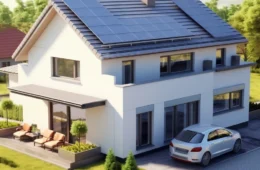
A solar carport is a canopy over one or more parking spaces with solar panels as its roof. It generates electricity, shelters cars and pairs naturally with EV charging. In Ireland they’re more common at businesses than at homes, partly because the planning rules and grants are less clear-cut than for an ordinary roof. This guide sets out what we could verify as of 26 October 2026. To estimate output for your site, try our solar carport calculator.
How a solar carport works
The structure is usually steel or aluminium, with panels mounted on a single slope or a shallow double slope. Cabling runs down a column to an inverter, which connects to the building’s electrical supply just like a rooftop system. Some designs add EV chargers to the columns, lighting underneath, or a battery. Because the frame is purpose-built, you can choose the orientation and tilt, which isn’t possible on an existing roof.
| Rooftop solar | Solar carport | |
|---|---|---|
| Structure cost | Uses existing roof | New canopy and foundations |
| Orientation | Fixed by the roof | Chosen at design stage |
| Roof condition issues | Yes (age, asbestos, load) | None |
| Planning | Wide exemptions since 2022 | Often outside the exemptions (see below) |
| Extra benefits | – | Shade and shelter for cars, EV charging point |
Solar carport planning permission
S.I. No. 493 of 2022, which sets the solar planning exemptions, doesn’t mention carports or canopies. The nearest category is “free-standing” solar, and its limits are tight:
- Houses (Class 2(c)): free-standing panels up to 25m² total aperture, no higher than 2.5m, not forward of the front wall, with at least 25m² of private open space left.
- Businesses, industrial, community buildings and farms (Classes 56, 61 and Part 3 Class 18(c)): free-standing panels up to 75m² total, no higher than 2.5m, and not forward of the front wall (or, for farms, of the nearest farm building to the road).
- Apartments (Class 60): free-standing panels are not exempt.
A canopy you can park a car under needs clearance above the vehicle, so in our reading many carports will exceed the 2.5m height limit and fall outside the solar exemption. That’s our interpretation, not a ruling. Other exemptions for structures within a house’s curtilage have their own conditions, and whether a solar canopy fits them is for your council to decide.
Our advice: ask your council for a Section 5 declaration, or apply for planning permission, before you order a carport. Check too whether the site is in an Architectural Conservation Area or a Solar Safeguarding Zone (43 zones around airports and helipads, listed on MyPlan, per gov.ie). SEAI’s business scheme guide says determining and obtaining planning permission is the applicant’s sole responsibility (SEAI).
Grants and tax for a solar carport
Homes
SEAI’s domestic solar electricity grant pays up to €1,800 for panels plus €600 for a 5kWh+ battery, but the grant page doesn’t say whether a carport-mounted system qualifies. On VAT, Revenue’s zero rate covers panels supplied and installed on a private dwelling, either fitted to the roof or ground-mounted beside it (Revenue). Whether a carport counts should be confirmed with SEAI and your installer in writing before you sign.
If you’re adding an EV charger, SEAI’s home charger grant pays up to €300, for a charger on SEAI’s Smart Charger Register at a home with off-street parking (SEAI).
Businesses
- SEAI Non-Domestic Microgen grant: for new applications from 6 October 2026 to 6 July 2027, SEAI pays the lower of its grant table and 45% of the invoiced cost, up to €325,200 (SEAI). The page doesn’t mention carports, and the terms allow one solar PV system per MPRN (SEAI terms). Confirm eligibility for a carport design with SEAI.
- Batteries are not eligible under the business grant (SEAI).
- Accelerated capital allowances: PV systems and inverters on SEAI’s Triple E register can qualify. Whether the canopy structure qualifies is a question for your accountant. See our ACA guide.
- VAT: VAT-registered businesses can generally reclaim VAT on costs used for taxable supplies (Revenue).
Grid connection
A carport connects like any other solar system. For homes and small sites, ESB Networks’ micro-generation route covers up to 25A single-phase (about 6kVA) or 16A three-phase (about 11kVA), notified on an NC6 form (ESB Networks). Larger systems go through the mini-generation route. Our post on the NC6 form explains the micro-generation step.
Sizing: an illustrative example
This is illustrative arithmetic only, with assumed numbers. Suppose a canopy over two parking spaces holds 8 panels of 450W each. That’s 3.6kWp. SEAI’s guide gives a well-located 3kW system as producing around 2,600kWh a year, about 870kWh per kWp. On that basis, 3.6kWp might produce in the region of 3,100kWh a year, if well-oriented and unshaded. Real output depends on orientation, tilt, shading and location; ask installers for a site-specific estimate, or use our calculator.
What to ask carport installers
- Who designs and certifies the structure, and what wind and snow loads is it designed for?
- What foundations are needed, and is any ground survey included?
- What clearance height is proposed, and how does that affect planning?
- Is the canopy waterproof, or do gaps between panels let rain through?
- Are the panels, inverter and any charger on ESB Networks’ Low Carbon Technology Register?
- What warranties cover the structure, the panels, the inverter and workmanship?
Is a solar carport right for you?
A carport tends to make sense when:
- Your roof is unsuitable (shaded, north-facing, fragile or asbestos)
- You have a car park with daytime demand nearby, such as an office, shop, hotel or factory
- You want covered parking and EV charging anyway
- You’ve already used your roof and want more generation
It’s harder to justify on cost alone at a home with a good south-facing roof, because the roof is free and the canopy isn’t. Get quotes for both before deciding. Businesses can see our industries we service page for sector-specific advice.
FAQs
Do I need planning permission for a solar carport in Ireland?
Probably, in many cases. S.I. 493/2022 doesn’t mention carports, and free-standing solar is only exempt up to 2.5m high. Ask your council for a Section 5 declaration before you build.
Can I get the SEAI grant for a solar carport?
SEAI’s grant pages don’t mention carports. Confirm eligibility with SEAI in writing before signing a contract and before any works start.
Is a solar carport zero-rated for VAT at home?
Revenue’s zero rate covers panels fitted to a private dwelling’s roof or ground-mounted beside it. Ask your installer and Revenue to confirm how a carport is treated.
Can a solar carport charge my electric car?
Yes, it can supply some of the electricity for an EV charger, especially in summer daytime. A charger can be added to the structure; homes may get SEAI’s €300 charger grant.
Get your solar quote today
Get your solar quote today. Thinking about a solar carport at home or for your business? Try the calculator, then tell us about your site and we’ll connect you with SEAI-registered installers for quotes. Call 089 450 4544 to talk it through.