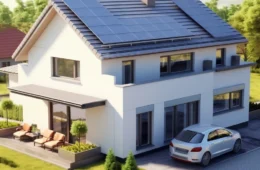
Putting solar panels on house roofs is now one of the most common home upgrades in Ireland: the Irish Times (15 October 2026) reported more than 200,000 homes with solar and over 31,000 SEAI solar grant applications in the first seven months of 2026. This guide takes you from “is my house suitable?” to the day the grant is paid, with every rule sourced and checked on 26 October 2026. If you want the headline numbers first, see our cost of solar panels in Ireland guide.
Is your house suitable for solar panels?
SEAI’s Homeowner’s Guide to Solar PV says any roof in good condition with no shading could work well. The main things an installer will look at:
- Orientation. South-facing roofs produce the most. East or west roofs produce more in the morning or evening, but less over the year (SEAI).
- Shading. SEAI warns that shadows can greatly reduce output, especially from objects less than 10 metres from the panels: chimneys, trees, a neighbour’s extension.
- Roof condition. Panels are expected to last more than 20 years, so the roof should too. SEAI notes extra timber supports may be needed and that installers should not drill through roof tiles, which can cause leaks.
- Your electricity use. SEAI says around 75% of a system’s output comes between May and September. Homes that use power during the day, or have a battery, an EV or a hot-water diverter, get more value from it.
If your roof is the problem, you aren’t necessarily out of options. Our guide to ground mounted solar panels covers garden arrays and their planning limits.
What size system does a house need?
System size is measured in kilowatt-peak (kWp). SEAI’s guide gives a worked example: a 20m² system of about 3kW “would generate around 2,600kWh a year if well-located”. SEAI also found that in an average Irish home, 80% of the electricity from a 2kW system would be used in the home (SEAI). Bigger systems export a larger share unless you add a battery or shift usage to daytime.
| System size | Illustrative panel count (450W panels) | SEAI panel grant |
|---|---|---|
| 2kWp | about 4–5 | €1,400 |
| 3kWp | about 7 | €1,600 |
| 4kWp | about 9 | €1,800 (cap) |
| Above 4kWp | 10+ | €1,800 (no extra grant) |
On a single-phase supply, which most houses have, ESB Networks’ micro-generation route covers inverters up to 25A, about 6kVA (ESB Networks). Anything above that needs a different, slower connection process.
Do you need planning permission?
Usually not for a house roof. Since 5 October 2022, the rooftop limit for houses has been removed: “There is no rooftop limit on houses, regardless of whether the house is located within or outside of an SSZ” (gov.ie). Conditions still apply under S.I. No. 493 of 2022, including keeping panels within 15cm of a pitched roof and at least 50cm from the roof edge. Protected structures and Architectural Conservation Areas have extra restrictions. We cover every condition in our planning permission guide.
Grants, VAT and tax for solar panels on house roofs
- SEAI grant: €700 per kWp up to 2kWp, then €200 for each extra kWp up to 4kWp, capped at €1,800 for panels. A €600 grant for a battery of 5kWh or more brings the maximum to €2,400 (SEAI).
- Eligibility: the house must have been built and occupied before 2025, have an MPRN and not have had SEAI solar funding before. You must use an SEAI-registered company.
- Enhanced grant: homeowners receiving certain Department of Social Protection payments, such as Fuel Allowance or Working Family Payment, can get up to €9,000 for panels and a battery (SEAI). See our free solar panels guide.
- VAT: supply and installation of solar panels on a private home is zero-rated, including a battery installed under the same contract (Revenue).
- Export income: your supplier pays for exported units under the Clean Export Guarantee (CRU). The first €400 a year of export income is exempt from income tax, USC and PRSI, extended to at least the end of 2028 (Irish Farmers Journal, September 2026).
SEAI puts the typical cost at €1,700–€2,500 per kWp before the grant (SEAI). The Irish Times reported €6,000–€9,000 after the grant for an average home.
From quote to grant payment: the process
- Get quotes. Ask at least two or three SEAI-registered companies to survey and quote in writing. Our compare solar quotes guide shows what to line up side by side.
- Apply for the grant online and wait for your approval. SEAI’s guide says you can’t apply if you’ve already started grant-aided works.
- Grid notification. Your installer submits an NC6 form to ESB Networks. SEAI says this usually takes at least 4 weeks (20 working days) (SEAI).
- Installation. Panels, inverter and any battery are fitted and commissioned by a Registered Electrical Contractor, who must give you a completion certificate (CRU).
- Post-works BER. A registered BER assessor completes a new BER for your home.
- Paperwork and payment. The installer uploads documents; SEAI says to allow 4 to 6 weeks for payment. Works must be finished within 8 months of approval.
Battery, diverter or neither?
A battery stores midday surplus for the evening. SEAI’s guide notes it raises the share of solar you use but adds cost, and some energy is lost charging and discharging (SEAI). A hybrid inverter is needed for a battery, so if you might add one later, ask for a battery-ready inverter now. VAT matters too: a battery installed with panels is at 0%, but a standalone battery later carries 23% VAT (SEAI application guide). Our post on solar panels with a battery vs without walks through the decision.
Living with solar: maintenance and monitoring
SEAI describes panels as needing very little maintenance and effectively self-cleaning, with occasional cleaning every few years (more often near the sea or a busy road). The inverter is the most common point of failure and may need replacing during the system’s life. Check your monitoring app or inverter regularly for fault lights, and confirm the meter reading rises each day.
FAQs
How many solar panels can I put on my house without planning permission?
There’s no rooftop limit for houses in Ireland since October 2022, provided you meet the conditions in S.I. 493/2022, such as edge distances and height above the roof. Protected structures and some conservation areas need to check with the council.
Will solar panels work on an east-west house?
Yes. SEAI says east or west systems produce more in the morning or evening but less over the year than south-facing. Many installers split panels across both roof faces.
How long does it take to get solar panels on a house?
Allow at least 4 weeks for ESB Networks after you have grant approval, plus scheduling. The installation itself is usually short. You have 8 months from SEAI approval to finish.
Do I need a battery to get the SEAI grant?
No. The panel grant is up to €1,800 with or without a battery. A battery of 5kWh or more adds €600.
Can I get the grant on a new house?
Only if it was built and occupied before 2025, according to SEAI’s current rules.
Get your solar quote today
Get your solar quote today. Tell us about your house, your roof and your bills, and we’ll connect you with SEAI-registered installers for itemised, no-obligation quotes. Prefer to talk? Call 089 450 4544.